
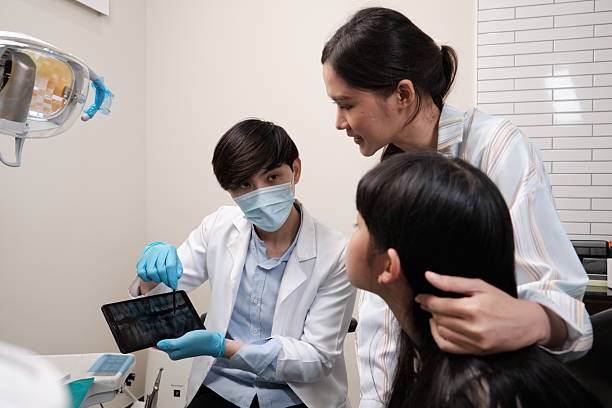
An impacted tooth is a permanent tooth that has not come into its expected place because something is blocking it, it is positioned at an unusual angle, or another developmental factor is keeping it from emerging normally. Impacted teeth in children are not only a wisdom tooth issue. Permanent canines, premolars, and other teeth can also get stuck during childhood or the teen years.
Three terms often get mixed up. Delayed eruption means a tooth is coming in later than expected but may still erupt normally on its own. Ectopic eruption means a tooth is following an abnormal path as it comes in. Impaction means a tooth cannot erupt normally because it is blocked or stuck. These conditions can overlap, but they are not interchangeable.
Parents often start asking questions when an adult tooth has not shown up or a baby tooth stays firm long after its neighbors are gone. Other common reasons for an evaluation include one side of the smile developing differently from the other or a dental X-ray showing a tooth in an unusual spot.
At My Rivertown Dentist in Madison, IN, Dr. Ashley Lee monitors how permanent teeth develop as part of pediatric dentistry in Madison. Not every late tooth is impacted, and not every impacted tooth needs surgery. If something about your child’s smile seems off, a visit with our Madison team can help you understand what is happening and what, if anything, needs to be done.
What Does It Mean When a Permanent Tooth Is Impacted?
A permanent tooth is impacted when it cannot move into its normal position in the mouth. It may stay partly or completely covered by gum tissue or bone, or it may be blocked by a neighboring tooth or another obstruction.
That is different from a tooth that just has not arrived yet. Permanent teeth come in on their own timelines, and a few months of difference is often normal. Impaction means something is physically in the way, or the tooth sits in a position that makes normal eruption unlikely.
How Permanent Teeth Normally Develop and Erupt
Each permanent tooth starts as a tooth germ, a small developing tooth inside the jawbone. As its root grows, the tooth slowly moves toward the surface along what dentists call the eruption pathway.
When a permanent tooth gets close, the root of the baby tooth it is replacing usually dissolves. The baby tooth loosens, falls out, and the adult tooth takes its place.
This happens in a general order, called the eruption sequence. During the mixed dentition years, roughly ages 6 to 12, your child has both baby teeth and permanent teeth at the same time. This is often when eruption problems first become noticeable.
Impacted Tooth vs. Delayed Eruption vs. Ectopic Eruption
These three conditions can look similar from the outside. Here is how they differ:
| Condition | What It Means | Can the Tooth Still Come In on Its Own? |
|---|---|---|
| Delayed Eruption | The tooth is later than expected but has a clear path | Often, yes |
| Ectopic Eruption | The tooth is coming in along an abnormal path | Sometimes, depending on its position |
| Impaction | The tooth is blocked or stuck and cannot erupt normally | Usually not without some form of help |
According to the National Library of Medicine, not every unerupted tooth is considered impacted. Impaction involves an obstruction, such as a neighboring tooth, bone, or soft tissue.
That is why your child’s age alone does not answer the question. What matters more is where the tooth sits and why it has not appeared. If your child’s tooth simply seems late, our guide to delayed tooth eruption in children explains when that is usually normal variation.
Can an Impacted Tooth Remain Hidden Beneath the Gums?
Yes. Some impacted teeth sit completely under the gum line or inside the bone, so they cannot be seen during a routine dental exam.
A dentist may use appropriate dental imaging to see where the tooth is, how it is angled, what surrounds it, and whether a permanent tooth is there at all. Sometimes the tooth is present but out of position. Other times, the permanent tooth never formed.
Which Permanent Teeth Commonly Become Impacted in Children and Teens?
Wisdom teeth are the most familiar example, but upper canines and premolars can also become impacted. Each type of tooth develops on a different timeline, so the concerns and next steps vary.
Impacted Upper Canines and Why Their Position Matters
Upper canines, sometimes called eye teeth, are the pointed teeth at the corners of the smile. After wisdom teeth, they are among the teeth most often affected by impaction, a condition dentists call maxillary canine impaction.
Part of the reason is distance. Upper canines start developing high in the upper jaw, near the base of the nose. They travel a long way before reaching the mouth, and they are usually one of the last front teeth to arrive. That long trip leaves more room for things to go off course.
When an upper canine drifts from its normal path, it is described in one of two general ways:
- Palatally displaced canine: The tooth sits toward the roof of the mouth, behind the other teeth.
- Buccally displaced canine: The tooth sits toward the lip or cheek side, in front of the arch.
The position affects how the tooth is evaluated and what options may make sense.
Canines have long, sturdy roots and help guide how the upper and lower teeth slide past each other when your child chews. They also shape the corners of the smile. A canine that hasn’t come in yet is not an emergency, but its position is worth keeping an eye on as your child grows.
Impacted Premolars and Other Permanent Teeth
Premolars sit between the canines and the back molars. They replace the baby molars, usually between about ages 10 and 12.
A premolar may have trouble coming in when:
- The baby molar it is replacing does not loosen and fall out as expected
- Nearby teeth have shifted into its space
- The developing premolar is tilted or rotated
- Something else, such as an extra tooth, is in the way
A baby molar that stays put longer than expected does not automatically mean the premolar is impacted. The premolar may simply be developing more slowly. Other teeth, including lower canines and occasionally front teeth, can also become impacted, but this is less common.
Impacted Wisdom Teeth in Teenagers
Wisdom teeth, or third molars, are the last teeth to develop. They begin forming in late childhood, continue developing through the teen years, and, if they come in at all, often erupt in the late teens or early twenties.
Because they arrive last, wisdom teeth often run out of room. Dentists typically start watching them on X-rays during the teen years to see how they are forming and whether there is space.
Evaluating wisdom teeth is a different conversation from managing an impacted canine in a younger child. Wisdom teeth are usually assessed later, and the decisions focus on space and long-term health rather than guiding a tooth into the smile.
Why Do Permanent Teeth Become Impacted?
Permanent teeth become impacted for several reasons, and crowding is only one of them. Causes generally fall into three groups: not enough space, a tooth developing in the wrong position, or something physically blocking the way. Often, more than one factor is involved.
Not Enough Space in the Dental Arch
Every permanent tooth needs room to come in. When the teeth are large compared with the size of the jaw, or when nearby teeth drift into an open space, the incoming tooth may not have enough room to emerge.
In that case, the tooth may come in crooked, stay partly covered, or remain stuck below the gums. If your child’s teeth already look tight, our article on crowded teeth in kids explains whether crowding is more of a space issue or a growth issue.
An Abnormal Eruption Path or Tooth Position
Sometimes there is enough room, but the developing tooth is angled the wrong way. Instead of moving straight toward its spot, it heads sideways, backward, or toward a neighboring tooth.
This is closely related to ectopic eruption, where a tooth follows an unusual path. Ectopic eruption does not always lead to impaction. Some teeth correct their course as they come in, while others become stuck.
Retained Baby Teeth and Problems With Root Resorption
Normally, a baby tooth’s root dissolves as the adult tooth developing next to it moves into position. When that process does not happen as expected, the baby tooth may stay firmly in place.
A baby tooth can be retained for a few different reasons:
- Its root did not dissolve on schedule
- The permanent tooth below it is out of position and is not pushing on the root
- There is no permanent tooth underneath at all
These situations are very different. A baby tooth that stays because the adult tooth is missing is a separate issue from one that stays because the adult tooth is displaced or blocked. A dental X-ray is usually needed to tell them apart.
Extra Teeth, Dental Cysts, or Other Physical Obstructions
Some children develop supernumerary teeth, or extra teeth beyond the normal set. An extra tooth in the upper front area is called a mesiodens. Extra teeth can sit in the path of a permanent tooth and keep it from coming in.
Less commonly, a dentist may find a cyst or another growth in the area. This is not a typical or expected cause, but it is one of the things imaging can help rule in or out.
Genetics and Other Dental Development Differences
Tooth size, jaw shape, and eruption patterns can run in families. Some research suggests that certain eruption problems, including canine impaction, may have a genetic component.
That said, a parent or sibling with an impacted tooth does not mean your child will have one. Family history is simply one piece of the picture your dentist considers.
Signs That a Child or Teen May Have an Impacted Tooth
Many impacted teeth cause no pain at all, so the signs are usually things you notice when you look at your child’s smile. None of these signs confirms an impaction on its own. They are simply good reasons to have a dentist take a closer look.
A Permanent Tooth Has Not Appeared When Expected
Permanent teeth come in over several years, and each tooth has its own typical window. For example, the ADA’s eruption charts show upper canines usually arriving later than lower canines.
Because timing varies so much, “late” depends on which tooth it is. One of the most useful clues is whether the matching tooth on the other side has already come in.
One Side of the Smile Is Developing Differently
Teeth on the left and right usually come in around the same time. When one canine or premolar has erupted and its partner on the other side is still missing, dentists call this eruption asymmetry.
A small delay is common. A difference that lasts many months, or keeps growing, is a better reason to check what is happening below the gums.
A Baby Tooth Remains Firm Longer Than Expected
If a baby tooth is still solid well after the same tooth on the other side has fallen out, it may be a sign the permanent tooth is not pushing on its root.
Please do not try to wiggle or pull a firm baby tooth at home. That tooth may be holding space, and in some cases there is no permanent tooth waiting to replace it. A dentist can tell you whether it should stay or go.
Swelling, Tooth Displacement, or Unusual Changes in the Gums
You might notice a firm bump on the gums or the roof of the mouth, a neighboring tooth that seems to be tipping or shifting, or swelling in one area.
These changes can come from many dental issues, not just impaction. Pain or swelling could also point to a cavity, a gum problem, or a tooth that is simply erupting. Any of them deserves an exam so your child gets the right answer rather than a guess.
Can an Impacted Tooth Affect Nearby Permanent Teeth?
Sometimes, yes. Whether it does depends on which tooth is impacted, where it sits, and how close it is to its neighbors. Many impacted teeth sit quietly without bothering anything, while others need closer attention.
Pressure and Root Resorption of Adjacent Teeth
An impacted tooth that sits against a neighboring root can put pressure on it. In some cases, this leads to root resorption, where the body gradually breaks down part of the neighboring tooth’s root.
This is most often discussed with displaced upper canines, which can sit close to the roots of the front teeth beside them. It does not happen in every case. It is one of the main reasons your dentist may recommend imaging and regular monitoring when a canine is out of position.
Crowding, Spacing, and Changes in Tooth Alignment
An unerupted tooth can also affect how the rest of the arch develops. Neighboring teeth may tip into the empty space, a gap may stay open where the tooth should be, or teeth may shift slightly out of line.
How much this matters depends on where the tooth is, how much space is available, and how your child’s jaws are growing.
Why Some Impacted Teeth Cause No Symptoms
Many impacted teeth do not hurt. A tooth can sit below the gums for years without your child feeling anything.
So a lack of pain does not mean everything is developing normally. At the same time, an unerupted tooth does not automatically mean something is wrong. That balance is why an exam and, when needed, an X-ray give you a clearer answer than symptoms alone.
How Madison Dentists Diagnose Impacted Permanent Teeth
Diagnosing an impacted tooth starts with a regular dental exam and, when needed, X-rays that show what is happening beneath the gums. Spotting an eruption concern is the first step. Building a full treatment plan, especially one that involves a specialist, comes after.
At My Rivertown Dentist in Madison, IN, regular checkups let Dr. Ashley Lee compare your child’s development from one visit to the next. That history makes it easier to tell a tooth that is simply taking its time from one that may need help.
Reviewing Eruption Timing and Dental Development
The exam looks at the bigger picture of your child’s dental development, including:
- Their dental age, or how far along their teeth are compared with typical patterns
- Which teeth have come in and in what order
- Any baby teeth that are staying longer than expected
- How much space is available in each arch
- Whether both sides of the mouth are developing evenly
When Dental X-Rays Help Locate an Unerupted Tooth
When a tooth has not appeared and something seems off, an X-ray is usually the next step. A panoramic X-ray shows all the teeth and both jaws in one image, which helps your dentist see whether a permanent tooth is present and roughly where it sits. Smaller X-rays taken from different angles can add detail about a specific tooth.
In some cases, a standard X-ray does not show enough detail. Our practice uses 3D imaging, which can show a tooth’s precise position and how close it sits to neighboring roots. This is not needed for every child. It is used selectively, when the added detail would change how the tooth is managed.
Determining Whether the Tooth Is Delayed, Displaced, or Truly Impacted
Putting the exam and imaging together, your dentist looks at several things:
- Where the tooth is and which way it is angled
- How much of its root has formed
- What surrounds it, such as bone, neighboring roots, or an extra tooth
- Whether it still has a reasonable path to come in
The answer helps determine whether the tooth is simply late, coming in on an unusual path, or truly stuck.
When an Orthodontist or Oral Surgeon May Be Involved
Some impacted teeth can be handled with monitoring alone. Others need a team approach.
An orthodontist may help with creating space or gently guiding a tooth into position. An oral surgeon may be involved if a tooth needs to be uncovered or removed. Your family dentist often coordinates the plan and helps you understand each step.
At My Rivertown Dentist, Dr. Lee monitors your child’s development, provides interceptive care when it fits, and helps coordinate a referral when specialist care is the right next step.
What Are the Treatment Options for Impacted Teeth in Children and Teens?
Treatment for impacted teeth in children depends on the specific tooth, where it sits, your child’s age, how much of the root has formed, how much space is available, and whether nearby teeth are at risk. There is no single approach that fits every case. The options below are general categories your dentist may discuss.
Monitoring a Tooth That May Still Erupt Normally
If the tooth has a reasonable path and nothing is blocking it, watching it over time may be the best choice. Your dentist will check its progress at follow-up visits and may repeat an X-ray to confirm it is moving in the right direction.
Monitoring is an active decision, not a wait-and-hope approach. It gives the tooth a fair chance to come in on its own while keeping an eye out for changes.
Creating or Preserving Space for an Unerupted Tooth
Sometimes a tooth is stuck mainly because there is not enough room. Orthodontic space management can help in two different ways:
- Space maintenance holds an existing gap open so neighboring teeth do not drift into it.
- Space creation uses orthodontic appliances to gently open up more room for the tooth.
Which approach fits depends on how much space is missing and how your child’s jaws are developing.
Removing an Obstruction or Retained Primary Tooth
In selected cases, removing what is in the way can give the permanent tooth a better chance to come in. That might mean taking out a baby tooth that has not fallen out or an extra tooth blocking the path.
This does not guarantee the permanent tooth will erupt on its own. Some teeth come in afterward, while others still need more help. Your dentist will usually keep monitoring after an extraction to see how the tooth responds.
Surgical Exposure and Orthodontic Traction
When a tooth is unlikely to come in by itself but is in a position that can be guided, a combined approach may be recommended.
In general terms, a surgeon uncovers the tooth by moving a small amount of gum tissue, and sometimes bone, out of the way. A small attachment is bonded to the tooth. An orthodontist then uses gentle, steady pressure over time to guide the tooth into its place in the arch.
Whether this is a good option depends on the tooth’s position, the surrounding anatomy, and the overall treatment plan.
When Extraction of the Impacted Permanent Tooth May Be Considered
Some impacted teeth cannot be moved into place in a predictable way. Others sit in a position where trying to move them carries more risk than benefit for the neighboring teeth.
In those situations, your child’s care team may discuss removing the impacted tooth and planning for the space it leaves behind. This is one option among several, and it is decided case by case.
Why Early Assessment Matters for Impacted Canines and Other Teeth
Catching an eruption problem early is about timing, not urgency. When a displaced tooth is found before it affects its neighbors, there may be more options to consider. That does not mean every finding needs treatment right away.
Why Growth Stage and Root Development Influence Treatment
A child’s teeth and jaws change quickly. A tooth with only part of its root formed may still have time to correct its path. Once the root is fully formed, the tooth’s ability to move on its own usually drops.
Some approaches, like removing an obstruction or creating space, tend to work best while a child is still growing. Your dentist considers where your child is in development when deciding what makes sense now and what can wait.
Why Waiting Until a Tooth Causes Pain Is Not a Reliable Strategy
Because many impacted teeth do not hurt, pain is not a dependable warning sign.
If you notice a persistent gap where an adult tooth should be, a smile that is coming in unevenly, or a baby tooth that will not budge, it is reasonable to ask about it at your child’s next visit. Many of these turn out to need nothing more than monitoring.
How Early Orthodontic Monitoring Fits Into the Treatment Plan
Watching how permanent teeth come in is a natural part of early orthodontic care. An eruption concern is one of several things that can be reviewed during an early orthodontic assessment, along with the bite, space, and jaw growth.
If targeted treatment is ever needed, it may be part of Phase 1 orthodontics for children, which focuses on specific developing problems during the mixed dentition years.
Frequently Asked Questions About Impacted Teeth in Children
Can a child have an impacted tooth before their wisdom teeth develop?
Yes. Permanent canines, premolars, and other teeth can become impacted during childhood or the teen years. Wisdom teeth are only one type of tooth that may fail to come in normally.
How can I tell whether my child’s permanent tooth is impacted or just late?
Usually, you cannot tell just by looking. A dentist checks the eruption pattern, available space, any retained baby teeth, and the tooth’s position, sometimes with X-rays, to see whether the tooth is delayed, out of position, or blocked.
Do all impacted permanent teeth need surgery?
No. Some teeth can be monitored, and others may benefit from creating space or removing an obstruction. Surgical exposure or extraction is considered only when the tooth’s position and the overall treatment plan make it the right choice.
Can an impacted canine damage nearby teeth?
Some impacted upper canines can contribute to root resorption or shifting of neighboring teeth. Appropriate imaging helps your dentist assess that risk and decide whether treatment or continued monitoring makes the most sense.
Will braces bring an impacted tooth into place?
Sometimes. Orthodontic treatment can guide some impacted teeth into the arch, occasionally after the tooth is surgically uncovered. Whether this is possible depends on the tooth’s position, the surrounding anatomy, the available space, and the risks and benefits for your child.
Should I be concerned if one adult tooth comes in much later than the same tooth on the other side?
Not always. A difference in timing can happen during normal development. A lasting or large difference is worth bringing up with your dentist, who can tell whether it reflects normal variation or an eruption problem.
Schedule a Permanent Tooth Eruption Evaluation in Madison, IN
If your child has an adult tooth that has not shown up, a baby tooth that will not loosen, or one side of the smile coming in differently from the other, a dental visit can help answer your questions.
At My Rivertown Dentist in Madison, IN, Dr. Ashley Lee reviews your child’s eruption pattern and overall development to see whether monitoring, imaging, or a specialist referral makes sense. Many late teeth simply need time, and impacted teeth in children do not always need treatment right away. When a tooth does need help, we will walk you through the options and why each one is being considered.
If you have questions about your child’s developing smile, schedule a permanent tooth eruption evaluation with our Madison team today.


