
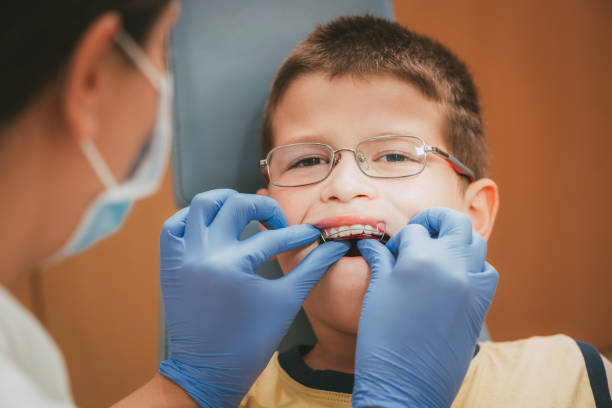
Starting orthodontic treatment while a child still has baby teeth can help with certain developing problems, but it does not prevent every future orthodontic issue. Phase 1 orthodontics is most useful when a specific problem, such as some crossbites, jaw shifts, or serious space shortages, is likely to be easier to manage during growth.
Phase 1 orthodontics, also called interceptive orthodontic treatment, is targeted treatment during childhood, usually while baby teeth and permanent teeth are both present. Its goal is not to straighten every tooth or deliver a finished smile. Instead, it addresses a specific developing problem at a time when treating it is clinically useful.
The usual path runs from a developing bite problem, to early diagnosis, to selected treatment if it’s warranted, to reassessment as the child grows. Some children then go on to a second phase of treatment, and some don’t.
A few points are worth knowing up front:
- Not every child needs Phase 1 orthodontics.
- Early treatment does not guarantee a child will avoid braces later.
- Phase 1 is not simply full braces started at a younger age.
- Treatment is recommended for specific clinical reasons, not because a child reached a certain age.
At My Rivertown Dentist in Madison, IN, Dr. Ashley Lee monitors how children’s teeth and jaws develop as part of pediatric dentistry in Madison. This guide explains what Phase 1 can realistically achieve, where its limits are, and how families and clinicians decide whether it makes sense.
What Is Phase 1 Orthodontic Treatment for Children?
Phase 1 orthodontics is a focused period of orthodontic treatment while a child’s teeth are still developing, usually before all permanent teeth have come in. It is also called interceptive orthodontics or early orthodontic treatment.
The goal is to address a specific developing malocclusion, a bite or alignment problem, that may respond better to treatment during growth. That is different from early diagnosis. Finding a developing problem does not mean treatment should start right away; often the right next step is simply to watch.
How Phase 1 Orthodontics Differs From Traditional Braces
Comprehensive orthodontics, the full course most people picture when they think of braces, aims to align the permanent teeth and set up a healthy overall bite. Phase 1 has a narrower aim, such as correcting a crossbite or clearing a path for a tooth that is blocked.
| Phase 1 Orthodontics | Comprehensive Orthodontics |
|---|---|
| Targeted early intervention | More complete alignment and bite correction |
| Often during mixed dentition | Often after more permanent teeth have erupted |
| Addresses selected developing problems | Addresses overall tooth and bite relationships |
| May be followed by observation or Phase 2 | Often the main comprehensive treatment phase |
Timing and goals vary from child to child, so this comparison describes typical patterns rather than fixed rules.
What Does Interceptive Orthodontics Mean?
“Interceptive” means stepping in on a problem that has already been identified while it is still developing, rather than waiting until every permanent tooth has arrived.
Examples include selected crossbites, a jaw that shifts sideways when the child bites, a tooth whose eruption is being blocked, significant space problems, and certain developing jaw relationships. Interceptive treatment can make some of these easier to manage, but it does not prevent every future orthodontic problem.
Why Phase 1 Often Takes Place During Mixed Dentition
Mixed dentition is the stage when baby teeth and permanent teeth are in the mouth at the same time, roughly from age 6 to age 12. It is a useful window because clinicians can see a lot at once:
- The order teeth are erupting in
- How much space is available in the dental arches
- How the upper and lower teeth meet
- How the jaws are growing
- Where individual teeth are positioned
- Whether crowding is starting to develop
This stage sits within the broader timeline of pediatric dental development, and it is often when developing problems first become visible.
What Problems Can Phase 1 Orthodontics Help Correct?
Phase 1 may help with selected crossbites, narrow upper jaws, functional jaw shifts, severe space shortages, teeth erupting out of position, some protruding front teeth, and certain developing jaw relationships. For each one, the value of early treatment depends on the specific diagnosis, and none of these outcomes can be guaranteed.
Crossbites and Abnormal Upper-to-Lower Tooth Relationships
In a crossbite, some upper teeth bite inside the lower teeth instead of slightly outside them. It can affect the front teeth (anterior crossbite) or the back teeth (posterior crossbite).
Timing can matter because some crossbites push the teeth or jaw into an off-balance position while the child is still growing. Early treatment may correct the tooth relationship and remove that interference. How it is treated depends on the type. A dental crossbite involves a tipped tooth. A skeletal crossbite reflects a width or growth difference between the jaws (a transverse discrepancy, when it is side-to-side). A functional crossbite happens when the jaw shifts to avoid a tooth contact.
Correction is not always permanent, and some children still need later treatment. Our guide to crossbite in children explains the types and signs in detail.
Narrow Upper Jaws and Transverse Growth Problems
Some children have an upper jaw that is significantly narrower than the lower jaw. This maxillary transverse deficiency can lead to a crossbite or a functional bite problem.
Because the upper jaw is generally more responsive to widening while a child is growing, this is one of the clearer situations where timing matters. Palatal expansion may be one option when it is appropriate. Learn more about how expansion works in our article on palatal expanders for kids.
Expansion addresses width. It does not by itself correct crowding, front-to-back bite problems, or tooth alignment.
Functional Jaw Shifts and Bite Interference
Some children slide their lower jaw to one side when they close, because a tooth contact gets in the way. This functional mandibular shift is often caused by an occlusal interference and is commonly seen with a unilateral posterior crossbite, which creates an asymmetric bite.
Correcting the interference during growth may let the jaw close in a more centered position. Early correction can be helpful, but it does not guarantee perfectly symmetrical facial growth.
Severe Crowding and Limited Space for Permanent Teeth
Whether permanent teeth have enough room depends on tooth size, arch length, arch width, and the order teeth erupt in. When the available space is much smaller than what incoming teeth need, some space-management steps may help.
It helps to separate three different goals. Space preservation holds existing room open. Expansion widens the arch when width is part of the problem. Comprehensive alignment, usually later, straightens the teeth themselves. Phase 1 may involve the first two, but rarely the third. Read more about crowded teeth in kids and whether crowding is a space or growth issue.
Permanent Teeth Erupting in Abnormal Positions
An early assessment may be appropriate when a permanent tooth is erupting outside its expected path (ectopic eruption), is blocked by another tooth, is displaced, or appears at risk of becoming impacted. A familiar example is permanent teeth coming in behind baby teeth.
Early action may clear the way for a tooth or reduce the chance of impaction. Still, not every crooked erupting tooth needs immediate treatment. Many settle as neighboring teeth come in.
Selected Protruding Front Teeth and Increased Injury Risk
Some children have upper front teeth that stick out noticeably past the lower teeth, a pattern called increased overjet. Prominent front teeth may be more likely to be injured in a fall or during sports.
Certain children with pronounced protrusion may be evaluated for early treatment, especially when injury risk or other individual concerns are present. However, early treatment does not consistently produce better final results than well-timed later treatment for every child with increased overjet. Phase 1 cannot promise to prevent injuries or eliminate later treatment.
Selected Developing Jaw Relationship Problems
Some children have front-to-back differences between the jaws. In a Class II pattern, the lower teeth and jaw usually sit further back relative to the upper. In a Class III pattern, the lower jaw sits forward, sometimes because the upper jaw is underdeveloped (maxillary deficiency).
During growth, some of these patterns may be assessed for growth modification, which can include functional appliances in selected cases. How predictable that treatment is depends on the diagnosis, the child’s mandibular growth pattern, and their stage of growth. Learn more about jaw growth differences in children.
Phase 1 cannot permanently control jaw growth or correct every skeletal difference.
What Phase 1 Orthodontics Cannot Reliably Correct
Phase 1 cannot guarantee that a child will avoid braces, predict every future growth change, align teeth that haven’t come in yet, fix every skeletal jaw problem, or serve as a reliable treatment for sleep apnea. Knowing these limits up front helps families set realistic expectations.
Phase 1 Does Not Guarantee That a Child Will Avoid Braces Later
Many children who complete Phase 1 still need comprehensive orthodontic treatment once more permanent teeth erupt. That does not mean the earlier treatment failed.
Phase 1 often solves a specific developmental problem, such as a crossbite or a blocked tooth. Phase 2, if it’s needed, then addresses overall alignment and how the full set of permanent teeth fits together. The two stages have different jobs.
Early Treatment Cannot Predict Every Future Growth Change
The jaws keep growing through childhood and adolescence. Treatment plans are based on today’s clinical findings and an assessment of growth, but no one can forecast exactly how a child will develop.
Growth patterns vary widely. Skeletal maturity arrives at different times, eruption can shift, and the bite can continue to change. That is why reassessment is built into early treatment rather than added as an afterthought.
Phase 1 Cannot Fully Align Teeth That Have Not Erupted Yet
Teeth that are still under the gums can’t be straightened. This is one of the main reasons comprehensive alignment usually waits until more permanent teeth are present.
An early appliance may correct one part of the developing bite, such as arch width or a single tooth’s path. It won’t produce the final alignment of teeth that haven’t arrived.
Not Every Skeletal Jaw Problem Can Be Corrected Without Later Treatment
Some significant skeletal differences between the jaws need additional orthodontic care as the child matures. In a smaller number of cases, a fully grown patient may be referred for a surgical evaluation.
That is not the usual outcome, and surgery is far from inevitable. It simply means early treatment isn’t a substitute for every future option.
Early Orthodontics Is Not a Guaranteed Treatment for Sleep Apnea or Breathing Problems
Orthodontic treatment can address particular dental or skeletal findings, and some of those findings are related to how a child breathes. Even so, early orthodontics should not be viewed as a universal fix for mouth breathing, snoring, or sleep apnea.
These symptoms can have several causes, including enlarged tonsils or adenoids, allergies, and nasal obstruction. Persistent snoring or breathing symptoms in children need medical evaluation, and orthodontic care may be one part of a broader plan rather than the whole answer.
Phase 1 vs. Phase 2 Orthodontics: Why Some Children Need Two Treatment Stages
Phase 1 corrects a specific developing problem during childhood. Phase 2, when it’s needed, provides comprehensive alignment and bite correction after more permanent teeth have come in. Between the two, there is usually an observation period while the child grows.
Phase 1 — Correcting a Specific Developing Problem
The first stage targets a clinically significant issue, such as a crossbite, a space shortage, an eruption problem, or a selected jaw relationship. The focus is on the objective, whether that’s centering the bite, holding space, or clearing a path, rather than on any particular appliance.
The Observation Period — Monitoring Growth and Permanent Tooth Eruption
After Phase 1, many children enter a period of observation. During this time, the dentist keeps an eye on:
- Eruption of the remaining permanent teeth
- Whether the bite stays stable
- How the dental arches develop
- Available space
- Changes from growth
This observation period is a planned part of care, not a sign that treatment stopped early. It lets the clinician see how growth and eruption play out before deciding on next steps.
Phase 2 — Comprehensive Alignment and Bite Correction
Phase 2 may use braces, clear aligners, or other appropriate appliances once more permanent teeth have erupted. Its broader goal is to coordinate the position of every tooth and how the upper and lower teeth fit together.
Can a Child Complete Phase 1 Without Needing Phase 2?
Yes, in some cases. But that outcome can’t be promised in advance.
Whether a child needs more treatment depends on the original problem, how well Phase 1 resolved it, how the remaining permanent teeth come in, and how the jaws continue to grow. Those factors only become clear over time.
What Age Should Children Be Evaluated for Phase 1 Orthodontics?
The American Association of Orthodontists recommends a first orthodontic check-up no later than age 7, or sooner if a parent or dentist notices a problem. Age 7 is a screening recommendation, not an automatic age to start treatment. For more on why screening matters, see our article on early orthodontic evaluations.
Why Age Seven Is Commonly Recommended for an Orthodontic Check-Up
By around age 7, most children have their first permanent molars and some permanent front teeth. That gives the clinician useful information about how the teeth and jaws relate to each other.
Identifying a problem at this stage leaves time to choose between monitoring and targeted treatment, rather than discovering it once the options are narrower.
Can a Five- or Six-Year-Old Need Early Orthodontic Evaluation?
Yes, when there is a clear reason. A noticeable crossbite, a jaw that shifts sideways, a significant eruption concern, or another clinically relevant finding can justify an evaluation before age 7.
That doesn’t mean young children routinely need treatment. Most simply need their development watched at regular dental visits.
Can Phase 1 Treatment Begin Later Than Age Seven?
Yes. Timing depends on the specific problem and the child’s stage of development. A child evaluated at 7 might start treatment later, when the timing is more favorable, or might never need Phase 1 at all.
What Appliances Are Used During Phase 1 Orthodontic Treatment?
Phase 1 may use palatal expanders, limited braces, removable appliances, functional appliances, or space maintainers, depending on the problem. Each serves a different purpose, so they are not interchangeable. The appliance is the tool; the diagnosis decides which tool fits.
Palatal Expanders for Upper Jaw Width Problems
A palatal expander widens a narrow upper jaw or arch, and it is most often used for selected side-to-side (transverse) problems such as certain posterior crossbites. Our guide to palatal expanders for kids explains how expanders work, when they are used, and what children experience.
Limited Braces or Partial Fixed Appliances
Limited braces are attached to only some teeth, often the front teeth, to correct a specific tooth-position problem such as a blocked or rotated incisor. This partial treatment has a narrow goal and is different from comprehensive braces, which address the whole bite.
Removable Orthodontic Appliances
Some removable appliances are used for particular goals, such as moving a single tooth or holding a correction. Because they can be taken out, results depend heavily on how consistently the child wears them, so families need to follow the appliance-specific instructions closely.
Functional Appliances for Selected Jaw Relationship Problems
Functional appliances are used in some treatment approaches for front-to-back jaw relationship problems. Outcomes depend on the diagnosis, the child’s growth stage, the appliance design, and cooperation.
Not every child with a recessed lower jaw is a candidate. Whether a functional appliance makes sense is an individual decision.
Space Maintainers and Eruption-Guidance Appliances
A space maintainer holds open the gap left when a baby tooth is lost too early, so neighboring teeth don’t drift into it before the permanent tooth arrives. That makes it different from orthodontic appliances that actively move teeth or influence growth.
Space maintenance is not automatically the same thing as Phase 1 orthodontic treatment. Learn more about space maintainers after early baby tooth loss.
What Happens During a Phase 1 Orthodontic Evaluation?
A Phase 1 evaluation reviews your child’s dental development, bite, and jaw growth to decide whether early treatment is actually indicated, or whether monitoring is the better choice. For Madison, IN families, it is a chance to get clear answers before committing to anything.
Reviewing Dental Development and Bite Concerns
The dentist looks at:
- Which baby and permanent teeth are present
- The child’s eruption stage
- How the teeth are aligned
- Space in the dental arches
- How the upper and lower teeth meet
- How the jaws relate to each other
- Oral habits such as thumb sucking or tongue thrusting
- Relevant medical history
Evaluating Jaw Growth, Crowding, and Crossbite
A clinical exam is the foundation. When it’s clinically helpful, diagnostic records add detail, such as photographs, models or digital scans of the teeth, and X-rays. These records show where unerupted teeth are, how much space is available, and how the jaws are developing.
Deciding Between Monitoring and Early Treatment
Most evaluations end in one of three broad outcomes:
- No orthodontic treatment needed right now, with routine dental visits continuing.
- Periodic monitoring of growth and eruption, to catch changes as they happen.
- Targeted interceptive treatment, or a referral for it, when a specific problem is likely to benefit.
Coordinating Pediatric Dental Care and Orthodontic Treatment
A family or pediatric dentist sees a child regularly and is well placed to notice developing problems early. Some practices also provide interceptive treatment directly, while specialist orthodontists handle more complex or comprehensive cases.
At My Rivertown Dentist, Dr. Ashley Lee monitors each child’s development, provides interceptive care when it fits, and helps coordinate a referral when a child needs specialist evaluation.
How Long Does Phase 1 Orthodontic Treatment Take?
There is no standard timeline for Phase 1, because it is a category of treatment rather than a single protocol. How long it takes depends on:
- What the treatment is trying to achieve
- The type of appliance
- How severe the problem is
- The child’s stage of growth
- How well the child follows instructions
- Follow-up visits
- Whether retention is needed afterward
Your clinician can give you an estimate once the specific treatment goal is clear.
Active Treatment vs. Growth Monitoring
Active treatment is the period when an appliance is working to correct the problem. Growth monitoring comes after, when the appliance may be off and the dentist is watching how growth and eruption unfold. The two can be very different in length, and monitoring often continues well after active treatment ends.
What Happens After Phase 1 Treatment Is Completed?
When the treatment goal is reached, the clinician reassesses the bite and, where appropriate, removes the appliance. A retainer or other retention may be prescribed to hold the correction. Monitoring then continues as the remaining permanent teeth come in.
Can Orthodontic Problems Return During Growth?
Yes, they can. Tooth positions and bite relationships may shift as the jaws keep growing and new teeth erupt. That is why retention and follow-up visits matter after early treatment. Read more about relapse prevention after early orthodontics.
Is Phase 1 Orthodontics Worth It for Every Child?
No. Phase 1 orthodontics is valuable when a specific clinical problem is likely to benefit from early treatment, not simply because starting earlier sounds better. Good care means telling those situations apart.
When Early Treatment May Offer a Meaningful Advantage
Early treatment may be most worthwhile for:
- A functional crossbite with a jaw shift
- A significant side-to-side mismatch between the jaws
- Selected eruption problems, such as a blocked or misdirected tooth
- Particular space-management problems
- Certain cases of injury risk or other developmental concerns
Even within these groups, the benefit depends on the individual diagnosis.
When Waiting and Monitoring May Be the Better Choice
Many children with mild crowding or developing alignment concerns can be monitored until treatment is more effective, often once more permanent teeth have arrived. Choosing to wait in these cases is a deliberate clinical decision, not neglect.
Why Starting Orthodontics Earlier Is Not Always Better
Early treatment can mean more appointments, more appliances, higher cost, and a longer overall treatment experience for the child. For some conditions, it doesn’t improve the final result compared with treating at a later, well-chosen time.
That is why timing should follow the diagnosis. The right question isn’t “How early can we start?” but “Will treating this now make a real difference?”
How My Rivertown Dentist Helps Madison Families Monitor Early Orthodontic Development
Routine pediatric dental visits at My Rivertown Dentist in Madison, IN give Dr. Ashley Lee regular chances to spot developing bite and jaw growth concerns early, and to talk with families about whether an early orthodontic evaluation would help. When treatment does make sense, our practice offers interceptive orthodontics in Madison as part of that care.
Monitoring Tooth Eruption, Space, and Bite Changes
At each visit, we track which teeth have come in, whether there’s enough room for the next ones, and how the bite is developing. Seeing a child over time makes it easier to tell a passing stage from a real trend.
Recognizing When an Orthodontic Referral Is Appropriate
Some developing problems call for a specialist’s assessment, such as complex skeletal differences or cases that need comprehensive orthodontic planning. When that happens, we help coordinate a referral so families know what to expect and why.
Helping Parents Understand Their Child’s Treatment Options
Our aim is to explain what we see in plain terms, lay out realistic options, including monitoring, and help each family make an informed decision that fits their child.
Frequently Asked Questions About Phase 1 Orthodontics
What is the main purpose of Phase 1 orthodontics?
Phase 1 orthodontics addresses selected developing bite, jaw, space, or eruption problems during childhood. Its purpose is not to straighten every tooth but to treat a specific issue when earlier intervention may offer an advantage.
Does every child need Phase 1 orthodontic treatment?
No. Many children benefit from an early orthodontic screening but do not need treatment during the mixed-dentition years. A clinician evaluates the child’s bite, jaw development, tooth eruption, and individual risk factors before recommending treatment.
Is Phase 1 orthodontics the same as braces?
Not exactly. Phase 1 may involve limited braces, an expander, a removable appliance, or another targeted intervention, depending on the diagnosis. Comprehensive braces are generally used to address broader alignment and bite relationships.
Can Phase 1 orthodontics prevent the need for braces later?
Sometimes a child won’t need further treatment, but Phase 1 does not guarantee braces will be unnecessary. Permanent teeth keep erupting and the jaws keep growing, so later orthodontic needs may become clear during monitoring.
What is the difference between Phase 1 and Phase 2 orthodontics?
Phase 1 focuses on selected developing problems during childhood, often while baby and permanent teeth are both present. Phase 2, when needed, focuses on more comprehensive alignment and bite correction after more permanent teeth have erupted.
Is age seven too young for an orthodontic evaluation?
No. A first orthodontic check-up by age 7 is commonly recommended because some developing bite and eruption problems can be identified at that stage. An evaluation does not automatically mean treatment should begin.
Can Phase 1 orthodontics correct an underbite or overbite?
Some developing bite differences may benefit from early intervention, but results depend on whether the problem is dental, skeletal, or both. Phase 1 cannot reliably correct every jaw relationship problem or guarantee that more treatment won’t be needed.
What happens if my child does not need Phase 1 treatment?
The dentist or orthodontist may recommend continued monitoring as permanent teeth erupt and the bite develops. Observation is often the right clinical decision, and treatment can be reconsidered if a specific problem develops or becomes more significant.
Schedule an Early Orthodontic Development Evaluation in Madison, IN
If you’re wondering about crowded teeth, a crossbite, how your child’s jaws are growing, or permanent teeth coming in out of place, an evaluation can give you clear, honest answers.
At My Rivertown Dentist in Madison, IN, Dr. Ashley Lee looks at your child’s individual development to determine whether early treatment would truly help or whether monitoring is the better path. The goal is a plan that fits your child, not automatic braces. When specialist care is needed, we’ll help coordinate the right orthodontic referral.
Ready to take the next step? Schedule a pediatric dental and bite-development evaluation with our Madison team today.


